
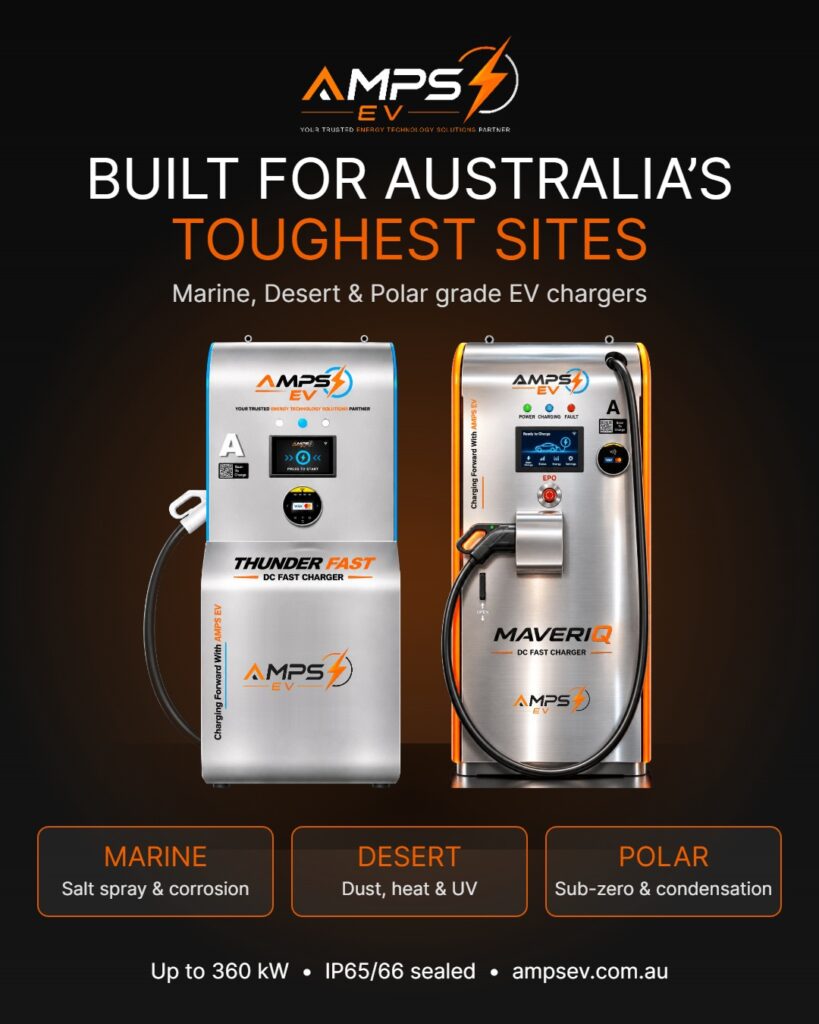
A standard EV charger is built for a car park. Put it on a wharf, a mine site or an alpine resort and it can fail within months. Salt, dust, heat and cold attack electronics, seals and connectors. That’s why our high-power chargers come in three grades built for Australia’s harshest conditions.
The three grades
| Grade | Built for | Protection focus |
|---|---|---|
| Marine | Ports, marinas, ferry terminals, coastal sites, electric boats and tugs | Salt spray, humidity and corrosion |
| Desert | Mines, outback roadhouses, remote depots, northern Australia | Fine dust, extreme heat and UV |
| Polar | Alpine resorts, cold stores, high-altitude and freezing sites | Sub-zero temperatures and condensation |
What changes inside a hardened charger
- Sealed enclosures rated IP65/IP66 keep out water jets, salt and fine dust.
- Corrosion-resistant finishes such as marine-grade stainless steel and protective coatings.
- Thermal management that keeps power electronics within safe temperatures in heat or freezing cold.
- Filtered, managed airflow so dust and salt don’t build up on circuit boards.
Which AMPS EV chargers come in these grades?
Our high-power DC range, including Maveriq (30 – 360 kW), ThunderFast (up to 350 kW), ThunderSource (1 MW cabinets, scalable to 4 MW), MegaThunder and Prometheus, is available in Marine, Desert and Polar grades. Our portable Briq and trailer-mounted Briq Away bring hardened DC charging to sites with no grid at all.
Real-world example
We’re currently working with a leading Australian mining company on charging for battery-electric tugboats, a project that needs Marine grade equipment able to handle constant salt exposure and very high power.
Learn more about our Marine Grade Solutions and Off-Grid EV Charging.
Planning charging for a port, mine or remote site? Talk to AMPS EV about the right grade for your conditions.